
Truth
I can't say if something is true, but I can recognise when it's false

This is section 2 of “Essay 0” which discusses my personal view of truth and builds on the ideas developed in “Reality”. This topic is very hairy and I'm trying to move away from it as fast as possible. I reckon this will be the densest section of the essay, so pat yourself on the back if you make it to the end; it’s probably smooth sailing after this one.
TL;DR “Truth” carries a sense of objectivity to it and yet it’s something that simply arises in our minds. Its inherent subjectivity is apparent in various domains (physics, maths, ethics). Ultimately, truth is best understood as consistency inside one’s growing system of statements also deemed as true.
Objective and Subjective Truth
We all have a fairly good internal understanding for what truth represents, yet it's surprisingly difficult to formally talk about it. In day to day life, when saying something is true, there is a certain sense of objectivity attached to the statement; something true often implies that it does not depend on the particular person making the statement, nor on the person hearing it. It is this exact intuition I find to be somewhat flawed as I claim that truth does not arise in a vacuum, but rather it arises inside a system (your mind).
An often used definition is that truth is the way reality is (this mostly aligns with the correspondence theory of truth). This of course raises the question: which reality? In line with the previous post, we have to distinguish between two different types of truth: objective and subjective truth; the former describes objective reality (and thus it is indeed independent of human perception), whilst the latter describes the subjective reality our brains constructed. My claim is that whenever we say something is true, we are silently referring to objective truth, whereas by definition it has to be the subjective truth that is in scope.
Imagine we are in the same room next to a carrot on a desk. Upon opening my eyes, the mind-carrot (the representation of the carrot my mind constructed) and the mind-desk arise in consciousness (as part of subjective reality). Due to their positioning in space, I observe that the former is on top of the latter. Hence I exclaim "The carrot is on the desk." and expect my interlocutor to agree with this truth. Instead, the only accurate statement I can make is “The mind-carrot is on the mind-desk.”. It is this nuance that is critical; the most I can do as a human is analyse the subjective reality I have constructed and come up with statements pertaining to it. Beyond that I can merely assume that my observation of the mind-carrot is linked to an observation in the objective realm; that the (objective) carrot is on the (objective) desk. As the other person constructs their own subjective reality by filtering objective reality, I'd hope that their own mind-carrot is on top of their own mind-desk.
We are left with a conundrum: whatever we could ever state about the world is subjective truth — a way of describing subjective reality, but this subjective truth need not be shared from the perspective of a different observer; it just empirically happens to be shared most of the time. The corollary of the simple observation that objective reality is always out of reach is that the objective truth associated with it is hermetically enclosed inside it, also out of reach. All that I could ever claim is true is simply a reflection of my own subjective reality.
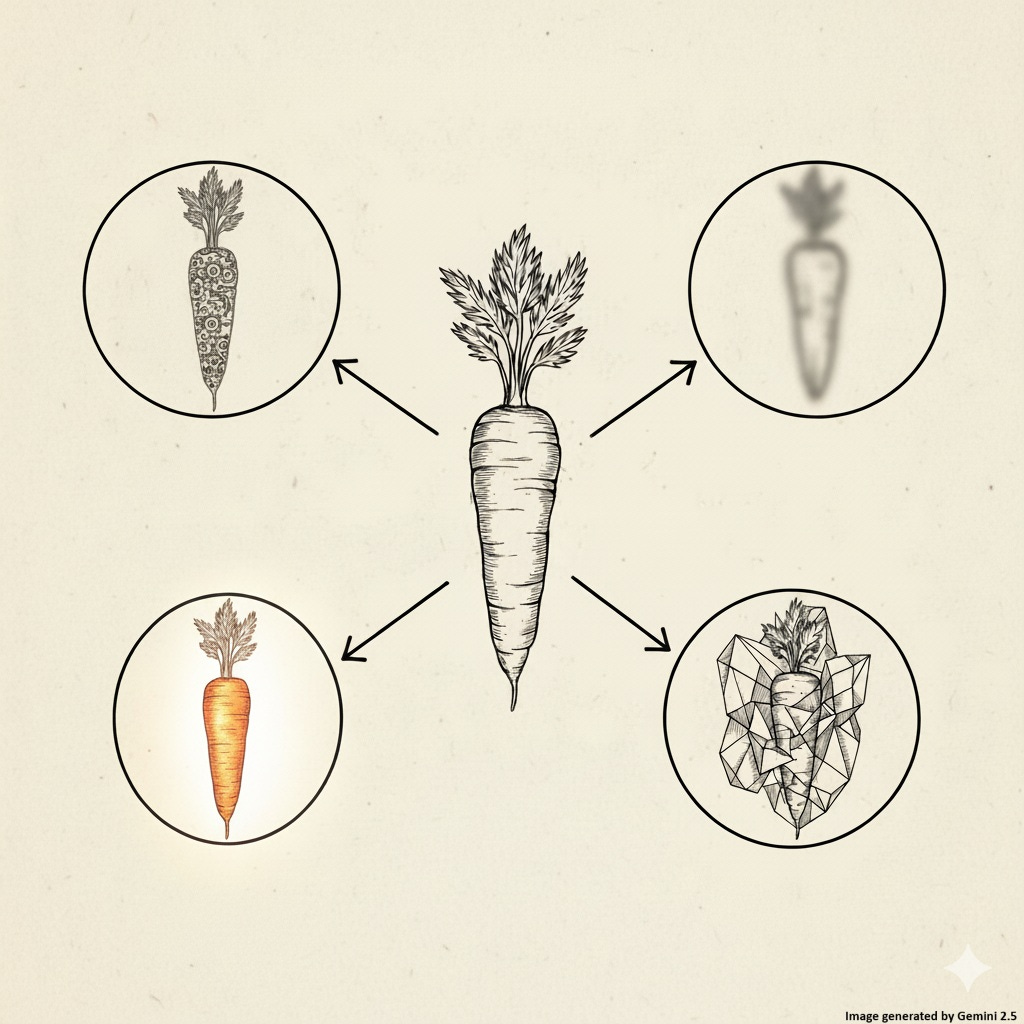
To further highlight how misleading our intuition for objective truth is, imagine how would you even put into words something that is objectively true? When becoming aware of the carrot on the desk, my mind would infer its size or its colour and I would call these observations truth. Yet, as part of objective reality, the carrot is a bunch of atoms glued together by fundamental forces. Its size or colour are notions which have some meaning for our minds, but are imperfect alterations of the totality that is the carrot. Even the atoms and fundamental forces that make it up are simply constructs that arise in my own mind. The very act of trying to imagine something that is objectively true relies on one's conceptual understanding of the world; and that is by definition subjective.
A good example of the above is the “orangeness” of the carrot that seems like the objective way to describe it. Yet, this "orangeness" does not lie with the carrot, but emerges inside your mind in the form of qualia (instances of subjective, conscious experience like the orangeness of the carrot or the jolt of pain you feel when stepping on a lego). To the blind person, the concept of orange is somewhat alien. She might learn to call a carrot orange as that’s what other people told her, but she will simply lack the qualia others experience because the electromagnetic waves bouncing off the carrot will elicit no response. Similarly, all aspects of the world which might appear objective are nothing more than products of the mind as it is the mind which gave them any sort of meaning to begin with.
Types of Truth
The above might indicate that only truth related to our direct interpretation of sensory input is in scope, e.g., the carrot on the desk. That is not the case: truth as a concept is multi-faceted and a comprehensive study of its semantics would merit a few essays on its own. For that reason, I will only attempt to distinguish some different types of “truth” and how subjectivity is inherent for all of them. This list is by no means exhaustive and just highlights how broad the term is when used in day to day life.
Physical Truth
This is what I associate with phenomena around us that can be directly observed. The apple falling to the ground, water boiling at 100 °C or the rising entropy of the universe are all examples of what I would describe as physical truth. It is the very particular way in which matter interacts with matter. It's born out of our ability to perceive the world around us, e.g., the apple is attracted to the ground. Inexplicably, my body is attracted to the ground in a similar fashion to the apple. The law of gravity can be posited to substantiate these 2 observations (and a bunch of seemingly unrelated phenomena). One cannot quite say why that law might hold... outside the fact that it seems to hold everywhere; it is the fact that my observations do not invalidate the law that make it compelling. At some point, a better law might arise that would be able to even more accurately describe that which we observe. (“The Structure of Scientific Revolutions" by Thomas Kuhn talks about this at large: how do scientific theories evolve? I can highly recommend it). Physical truth stands because it is corroborated by the empirical observations we can make about the world.
Mathematical Truth
I shall call mathematical truth that which emerges out of necessity from an agreed upon set of axioms. If 2 individuals are in complete agreement on a set of axioms, then any statement resulting from that set of axioms shall be true by design. To a certain extent, mathematical truth comes close to what one might imagine “objective truth” to be. The objectivity is arising from the minimal reliance on human perception as once the axioms have been laid out, the subjectivity seemingly vanishes. Granted, one still needs to conceptualise what an axiom even is; and by that very act subjectivity rears its head once again.
Take for example the axiom of extensionality in ZFC. It sounds very fancy (mathematicians love to do that), but it simply states that two sets are equal if they have the same elements. As much as it sounds obvious, this axiom still represents an abstraction of how humans imagine the world around to work. If I’m holding a carrot and a cabbage in my bindle and you’re holding a cabbage and a carrot in yours, we’d say my set of vegetables is the same as yours. Yet, even this “sameness” is vague; it’s definitely the case that the colour of my cabbage is ever so slightly different from yours and the size of your carrot is ever so slightly different from mine. They are for sure not quite the same, but rather the abstract terms of cabbage and carrot apply in both cases ignoring any of the other properties we can relate to what we observe. The contents of my bindle being the same as yours is an abstraction still making direct use of our perception and interpretation of the situation. Subjectivity has not been circumvented, but rather has been encoded inside the axiom.
The mathematical type of truth does invariably result from the axioms, but the axioms do not evade subjectivity. Often, people call maths the language of the universe: something that was hidden for us to discover, but nothing was discovered... it was merely created. Saying that 2+2 is always 4 does not say anything about the Universe, it says something about the very specific way we're trying to make sense of the Universe. “2” is a useful tag I can assign to a collection of objects and so is “4”. I did not discover something fundamental about matter, rather I managed to assign tags to matter that was already there, waiting to be perceived.
Ethical Truth
Despite being one of the most elusive types of truth, it would be a shame not to mention it. Ethical truth is meant to describe what is good and bad and how to live life in an ethical manner. Whereas physical truth describes the physical phenomena around us and mathematical truth is trying to come up with undeniable statements once a common set of axioms is defined, ethical truth can inherit properties from both and yet manages to be none altogether.
Coming up with ethical truth and packaging it as physical truth is done by observing the world around and assigning laws to empirical observations. Sharing a toy with the other kid teaches cooperation and compassion so we deem it to be good. People that fall prey to illicit substances usually ruin their lives in the process so we deem drugs to be bad. Ethical truth can be built on top of our observations of the world and we then try to generalise them in an attempt to construct a system that could mimic science.
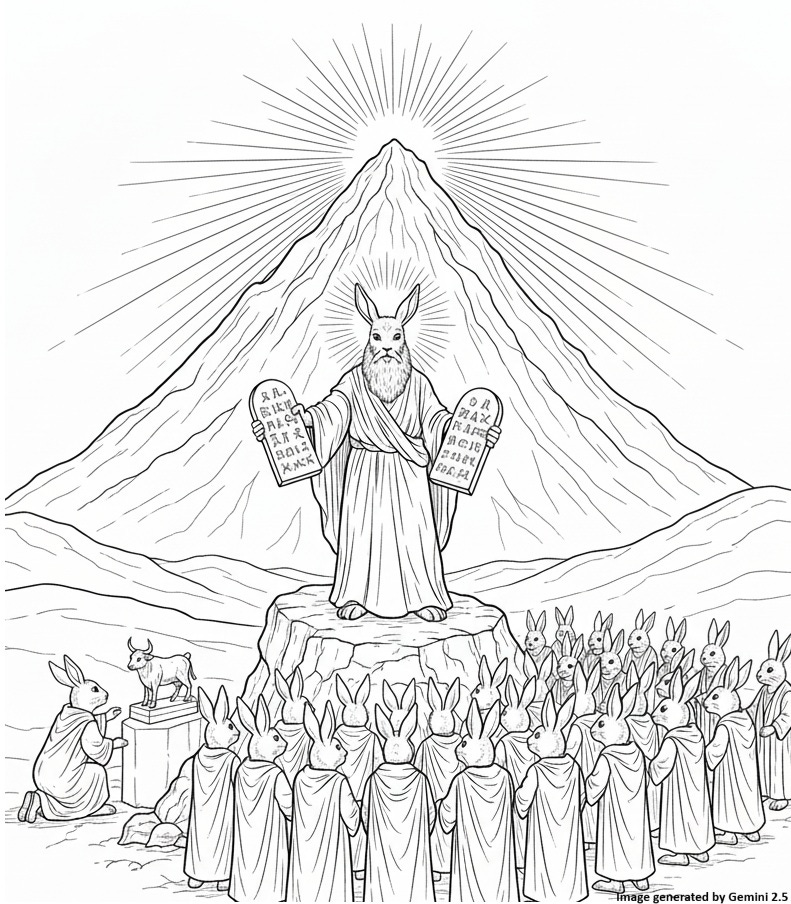
A more axiomatic approach has been employed by religion where the empirical observation is replaced by statements that are unquestionably true as coming from a divine being. When Moses came down Mount Sinai with the 10 commandments, he did not start debating which commandments should be followed, which ones he didn’t agree with or which ones should be amended; he put the 2 tablets down and said something to the effect of “Yo my dudes, this is truth”. I do think that a shared set of moral values is paramount for a society to function; what I find surprising however is how a lot of people regard these values as if they were objective (and applicable to all societies throughout different eras). Unless one accepts a metaphysical being that knows better (and I won’t beat that horse for now as it’s dead and we have killed it), it very much seems like ethical truth relies on what we happen to collectively believe is good or bad at that point in time. Subjectivity is intrinsic.
Truth as a matter of consistency
The whole conceptual appeal of objective truth is that it leaves no room for interpretation. Yet, as it should be clear by now, subjectivity can not be avoided; it is our minds where the whole idea of truth even arises. That raises a question that is central to this essay: how can I prove to someone that a statement is true given we are working with distinct subjective realities? Maybe in my own subjective reality, all carrots are blue and you have no way of experiencing that for yourself. There is a simple observation that is central here: despite how hard it is to recognise if something is true, it's quite straightforward to recognise it as false.
You could tell me that all liquids boil at 100 °C and I'd be inclined to believe you; upon trying to boil some alcohol though, I'd quickly realise that statement must've been false as vapour starts appearing way before the 100 °C mark. Similarly, I could believe the number 667 is prime at first glance until I'm able to factorise it as 23 × 29. When tackling the sensitive topic of abortion, I could wonder for ages if the statement "abortion should be forbidden" is true without a clear answer; it is my belief that people should have control over their own bodies that makes this statement false (for me). With that in mind, the tool I propose is the following:
Something is true as long it produces no contradiction inside a given system.
This system is usually enclosed inside one's mind and is made up of all the statements one holds as true already. Do note that it may be that neither a statement S nor its negation ¬S produce a contradiction inside one's system. Then one has a choice: say that S is true, say that ¬S is true or add neither to the system (for now) allowing it to live in a sort of limbo. Critically, this definition implies that a statement's truth value can be ascertained only in relationship to a person's subjective reality.
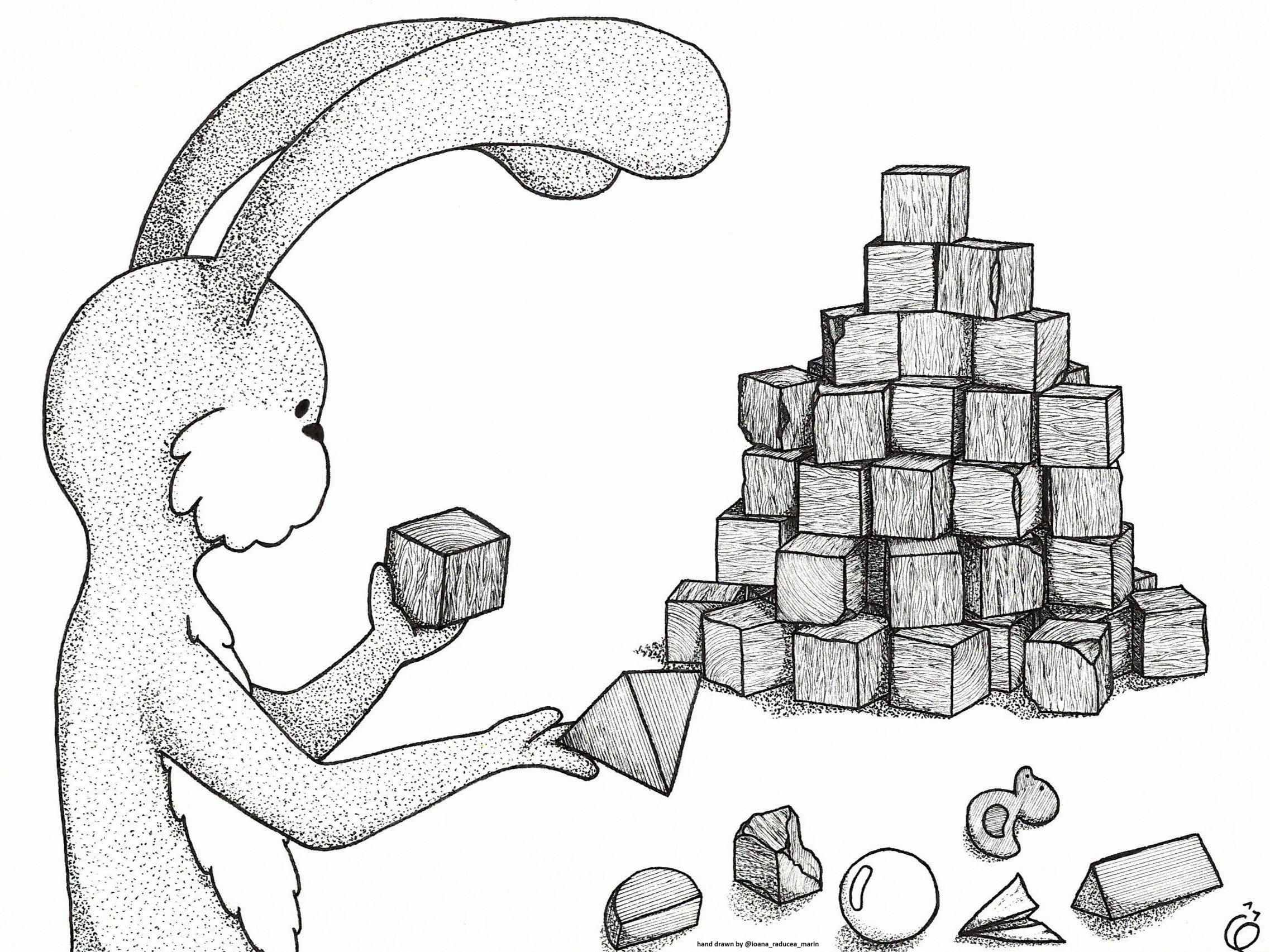
This approach to truth is very similar in spirit to how science is done. In science, a theory is valid as long as its predictions do not contradict the empirical observations we have about the world (and new observations may well invalidate the theory later). For a person, at any point in time, there is a set of statements about the world they would deem as true. A new statement (living in a limbo until that point) is true as long as it leads to no contradiction in that system; if so, it can be added to the system, enlarging the field of what one regards as true. If added, its negation will trivially become false and the whole system will place further restrictions on which other statements could be true. In maths lingo, such a system may well be incomplete (a formal system is complete if any statement can be proved to be true or false. An incomplete system might have statements which can neither be proved nor disproved), but is necessarily consistent (in mathematical logic, a formal system is consistent if no statement can be proved to be both true and false).
This shifts the problem from deciding if something is true to deciding if something is not false. When opening my eyes and seeing a carrot on the desk, the statement "the carrot is on the desk" is true as it does not contradict any of the external stimuli I used or my past knowledge on carrots. The statement is not true in a vacuum, but rather it's the inability to negate it in my own subjective reality (where the mind-carrot is on the mind-desk) that validates it. This way of going about truth may seem contrived, but is a reflection of the limited understanding of the world we have as humans; one cannot reduce every statement to first principles, but has the natural ability to recognise if that statement might violate some previously held truth about the world. One's truth can only crumble as a result of one's system: it is consistency that glues the whole thing together. I am right or wrong on a given matter as a direct result of all the other things I deem as true.
Importantly, this technique for judging if something is true means that 2 people can theoretically assign different truth values to the same statement if they use different systems to begin with. I will delve deeper into that in future posts!
P.S. I think the tool I arrived at is similar in nature to the coherence theory of truth, altho it seems to diverge at some point afaict. Any comment on the matter from someone that delved very deeply into epistemology (and theories of truth in particular) is more than welcome.